Who is your audience? Before you build your story map, think about who will be seeing your story. Craft your text, maps, and other content to suit your audience. Avoid jargon and use accessible language. It's not about dumbing down; it's about striving for clarity and simplicity.

Start your story with a bang. Choose an image that's exciting and attractive. Craft your title to be active and descriptive. "Walking Tour of Springfield" is okay, but "Discover the Hidden Treasures of Springfield" is better. Make sure people know where they are. Springfield, Illinois, or Springfield, Massachusetts? Put your core concepts at the beginning rather than the end. Don't include outbound hyperlinks in your introduction that would distract someone from starting to navigate through your story—put those at the end.
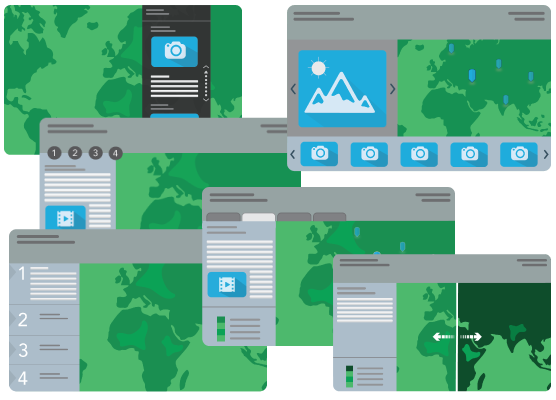
The Esri Story Map application templates come in a variety of flavors. Choose an app with a user experience appropriate for your story. The Story Map Tour, for instance, is great for sets of places with photos and short captions. If you have longer text, the Story Map Journal might be better. If you want your audience to be able to compare different maps, the Story Map Series makes the most sense. For a long, less structured narrative that people read like a web page, use the Story Map Cascade. See the Story Map Apps page to get started and to compare the available apps.
Make sure your maps are as simple, clear, and user-friendly as possible while incorporating cartography that matches your project. Edit your map to eliminate unnecessary detail. Choose an appropriate basemap; for example, in many cases, a simple gray background map might be better than satellite imagery. Think about what custom pop-ups, legends, and symbology you want to provide to deliver your map's message.
Stories are distillations. The more you do to remove nonessential elements, the more likely you are to tell an effective story. Remember that attention spans are short in the digital age. Shorten your text and simplify your maps—and then go back and do it again. A person should not have to get to the fifth or sixth section in your story to understand its underlying concepts and mission.